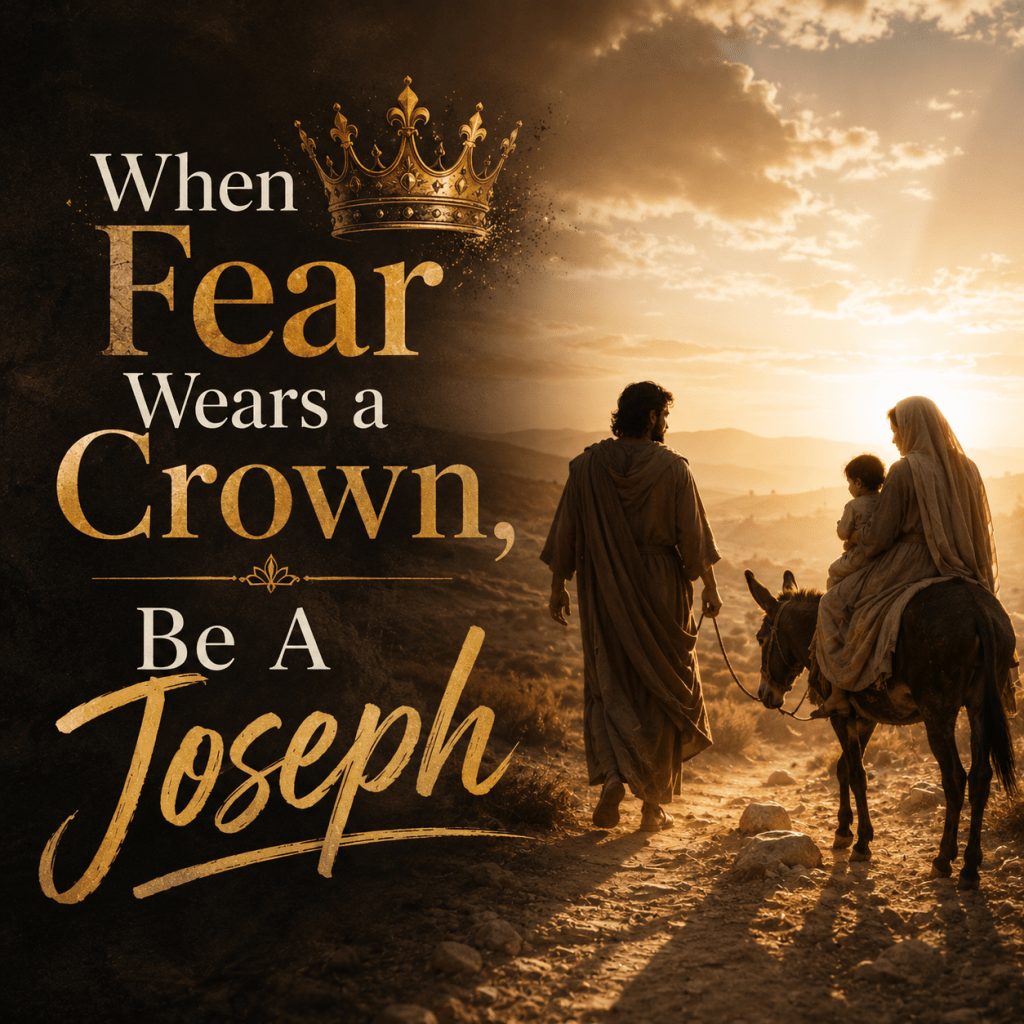
Some Scriptures leave me feeling comforted. Others leave me scratching my head. Today’s passage left me angry.
Not the polite, church-approved kind of anger either. I mean the kind that tightens your jaw and makes you mutter, “Are you kidding me?” under your breath. Matthew tells us that Herod, terrified that someone else might threaten his power, orders the murder of every little boy under the age of two in and around Bethlehem. An entire generation of parents wakes up to unimaginable grief because one man could not imagine a world where he wasn’t the center of it. And as I sat with that this morning, my first thought wasn’t, “What a terrible story.” My first thought was, “We’re still living it.”
The retreat guide reminds us that Jesus entered a real world with real politics, real oppression, real economic struggles, and real fear. God didn’t lower a rescue rope from heaven and pull humanity out of history. God stepped into history itself. Jesus didn’t bypass injustice; He was born into it. Before He ever preached a sermon, healed a disease, or carried a cross, He became a child whose parents fled across a border in the middle of the night because a ruler believed his own power mattered more than innocent lives. The Holy Family were refugees long before we ever called them holy.
As I read the story, I found myself thinking about Herod, and if I’m honest, I immediately knew exactly who my Herods were. That’s the easy part, isn’t it? We all have a list. Politicians we can’t stand. Leaders we don’t trust. Commentators who make our blood boil. Every generation has its Herods, people so intoxicated by power that they begin believing they alone can save the nation, the church, or the world. History has never suffered from a shortage of fearmongers. Fear has always been one of the cheapest and most effective campaign strategies. Convince people they’re under attack, promise you’ll protect them, and suddenly they’ll surrender almost anything in exchange for the illusion of safety.
But somewhere in the middle of my prayer, Jesus quietly turned the mirror around. “What if the point of this story isn’t simply to identify Herod?” “What if it’s to understand how someone becomes Herod in the first place?” Now that’s a far more dangerous question. Because Herod didn’t wake up one morning thinking, I’d really like to become the villain in the Christmas story. Evil almost never introduces itself that way. It usually disguises itself as righteousness. Herod wasn’t trying to become evil in his own mind. He was trying to preserve what he believed was rightfully his. His throne. His influence. His identity. His certainty. His future. Fear slowly baptized itself as virtue until protecting his kingdom became more important than protecting God’s people.
That’s the subtle poison Matthew wants us to see. Herod never says, “I hate children.” He says, “I have to protect my throne.” And once preserving the throne becomes the highest good, almost anything becomes justifiable. The uncomfortable truth is that Christians are not immune to this temptation, In fact, sometimes we’re especially vulnerable to it because we become convinced we’re defending God. But here’s the irony that hit me like a freight train this morning: nowhere in Scripture does God ask me to protect His Kingdom. God seems to be doing just fine at that. What He repeatedly asks me to protect are His people.
I wonder how often we’ve confused those two. Some Christians spend more energy defending Christianity than they do embodying Christ. We can become so committed to winning arguments that we forget we’re called to wash feet. We become experts at protecting doctrine while ignoring the people standing right in front of us. We wield Scripture like a weapon instead of receiving it like a mirror. We proclaim the Prince of Peace while cultivating outrage as though it were one of the fruits of the Spirit. We become so certain we’re right that we stop being curious, compassionate, and humble. We begin dividing the world into “our people” and “those people,” forgetting that Jesus had an annoying habit of calling all of them neighbors.
Maybe that’s how Herod quietly slips into the Church. Not because Christians become monsters overnight. Because fear slowly becomes more familiar than love. Control becomes more comfortable than trust. Certainty becomes more important than compassion. Power becomes more valuable than people. Then Matthew shifts the camera, and standing on the other side of the story is Joseph.
Joseph never gives a speech. He never wins a debate. He never posts a manifesto. He simply gets up in the middle of the night, gathers his family, and protects a vulnerable child. That’s it. The entire contrast between the kingdoms of this world and the Kingdom of God is wrapped up in one exhausted father quietly packing for an uncertain journey. Herod builds his kingdom by sacrificing children. Joseph sacrifices everything to protect one.
What a stunning contrast. Herod asks, “What must others lose so I can keep my power?” Joseph asks, “What must I lose so others can live?”
I couldn’t help thinking about our own world. Every day we are invited to choose which kingdom we belong to. Every day we decide whether our politics matter more than people, whether our ideology matters more than mercy, whether our comfort matters more than our neighbor, whether being right matters more than being loving. The question isn’t simply whether there are Herods in Washington, Moscow, Jerusalem, or anywhere else. The harder question is whether there is a little Herod quietly building a throne inside my own heart every time I make another human being expendable for the sake of my comfort, my tribe, my certainty, or my fear.
Then came what felt like the Spirit’s mic-drop moment. Maybe Matthew isn’t asking, “Who is Herod?” Maybe he’s asking, “Will you become Joseph?” Will you quietly protect the vulnerable without needing recognition? Will you refuse to let fear dictate how you treat other people? Will you make room for refugees because your Savior once was one? Will you choose compassion when outrage would earn more applause? Will you trust that God is fully capable of defending God’s Kingdom, freeing you to spend your energy defending God’s children instead?
That’s a very different way to follow Jesus. Maybe the Church doesn’t need more Herods convinced they’re saving the faith. Maybe it needs more Josephs quietly carrying Christ through a frightened world. Because history will always produce another Herod. The Kingdom of God has always been built by ordinary people who, in the darkness of the night, simply get up, trust God, and carry love to safety.
 Holy Shift Blog
Leave a comment